


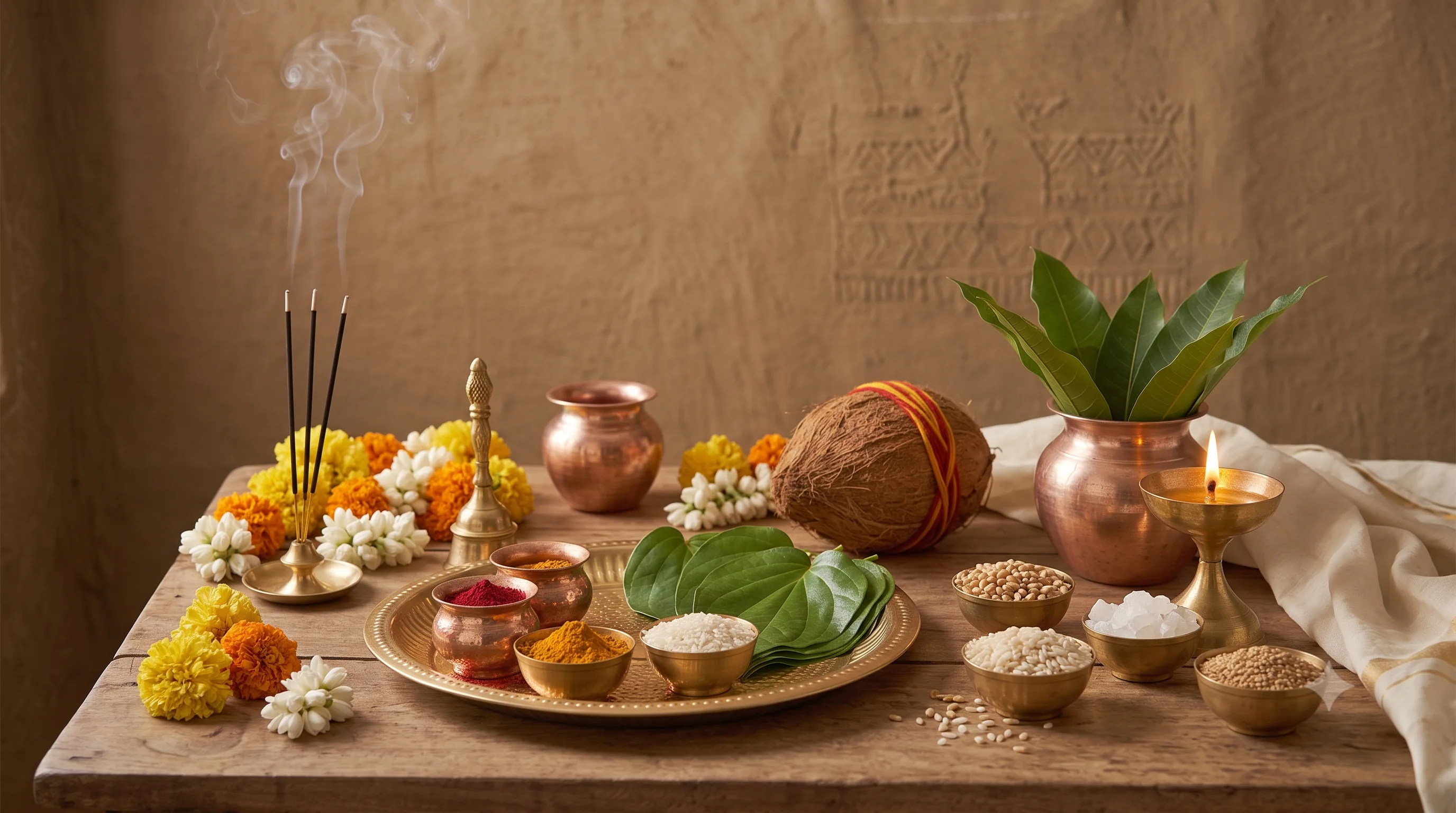
Puja samagri is never arbitrary. Every item is either an offering to a sense, a symbol of a quality, or a practical requirement of the rite. This guide explains the framework the whole Samagri Catalogue rests on — and points to the sixteen guides that cover the items themselves.
Avyani's Master Samagri Catalogue records around a hundred and forty items across seventeen categories. Seen as a list it looks daunting. Seen as what it is — a small number of ideas, elaborated — it becomes straightforward, and that is what this guide sets out.
The Measure the Tradition Sets
The Bhagavad Gita is unambiguous about how much is required: patram pushpam phalam toyam — a leaf, a flower, a fruit, water; whoever offers these with devotion, that is accepted (9.26).
Everything that follows is elaboration on that verse, and none of it outranks it. A worshipper with a flower and a cup of water is not doing a lesser thing than one with a full kit. This is worth stating plainly at the head of a catalogue, because a catalogue by its nature suggests otherwise.
Upachara: the Grammar of an Offering
Formal puja is built from upachara — acts of service offered to the deity as a guest. The shorter sequence, panchopachara, has five:
- Gandha — fragrance: sandalwood, and the powders that mark deity and devotee.
- Pushpa — flowers and leaves, offered loose or as a garland.
- Dhupa — incense smoke, and dipa, the lamp.
- Naivedya — food, offered and then shared as prasad.
Each of these has its own guide, linked in the next section. The fuller shodashopachara extends them to sixteen, adding the reception of a guest: a seat, water for the feet, water to sip, the bath of abhishekam, cloth, ornament, and finally leave-taking. Read that way, the catalogue stops being a shopping list and becomes hospitality — which is exactly what it is.
What Each Category Contributes
Materials offered and consumed. Flowers and Leaves, Powders and Sacred Marks, Liquids and Panchamrit, Fruits, Grains, Naivedya and Vrat Falahaar. These are bought fresh, offered once, and shared or returned to earth.
What carries the offering. Kalash and Utensils covers the vessels and tools — the kalash, lamp, bell, thali, conch and the havan set — which are kept and reused rather than consumed.
What burns. Incense, Camphor, Oils and Ghee for the daily flame, and Havan Samagri, Wood and Fuel for the fire rite, with Havan Samagri: What You Need for a Fire Ritual covering how to run one safely.
What is worn, tied and dressed. Cloth and Sacred Threads and Jewellery and Sacred Items — the vastra offering, the janeu and mauli, malas, ornaments and yantras.
Everything else. Miscellaneous gathers the occasion-specific items: the wedding stone, the Upanayana staff, the clay Ganesh idol, mehendi, and the pilgrimage bundles.
How to Read Avyani's Guidance
Across all sixteen guides, four kinds of statement are kept apart, because they do not carry the same weight.
- Scripture — a named text, chapter and verse you can check. Bilva in the Shiva Purana, durva in the Ganapati Atharvashirsha, the wedding stone in the Ashvalayana Grihya Sutra.
- Tradition — established paddhati and stotra practice, widely taught, without a single locator. Most of what happens at a home altar sits here, and it is not diminished by saying so.
- Regional practice — genuine and respected, but specific to a region, sampradaya or family. Turmeric plant at Pongal, hibiscus for Kali in Bengal, the sieve at Karva Chauth.
- Practical guidance — Avyani's own advice on buying, handling, safety and disposal. Clearly ours, and clearly not scripture.
Where a claim is widely repeated but we cannot name a source for it, we say so rather than dressing it in a citation. Where a family tradition differs from anything in these guides, the family tradition is the one to follow.
Mandatory and Optional
Every catalogue item carries a mandatory or optional flag, and every guide repeats it. These are Avyani planning values, used for assembling kits and estimating supply. They are not a shastric ruling on what a rite requires.
A priest planning a specific puja will ask for what that puja needs, which may be more or less than the catalogue suggests. The flag answers "what does a general-purpose kit contain", not "what did the texts prescribe".
Four Rules That Cover Most of It
- Buy from someone who will say what is in it. Powders, resins, samagri mixes, incense and colours all conceal their composition, and colour, price and fragrance prove nothing.
- Fresh and small beats large and tired. A modest handful of fresh flowers or fruit is the better offering, and it does not sit around spoiling.
- If it will be eaten, treat it as food. Panchamrit, naivedya and prasad are food from the moment they are bought.
- If it burns, ventilate and never leave it. Lamps, incense and havan are open flames in a room.
For storing and retiring what you have bought, see our Caring for Puja Samagri at Home guide. For the full list, browse the Samagri Catalogue.
Sources
- Bhagavad Gita 9.26 — Sanskrit text with translation.
- Panchopachara and shodashopachara — standard sequences of formal puja; the exact composition of the sixteen varies between paddhati.
- Category structure, item counts, and mandatory flags — Avyani Master Samagri Catalogue v1. Mandatory and optional are Avyani planning values, not scriptural prescriptions.
- Scriptural locators named above are cited in full in the individual guides they belong to.
Where a scriptural locator could not be verified, the statement is given as tradition or regional practice rather than scripture.