


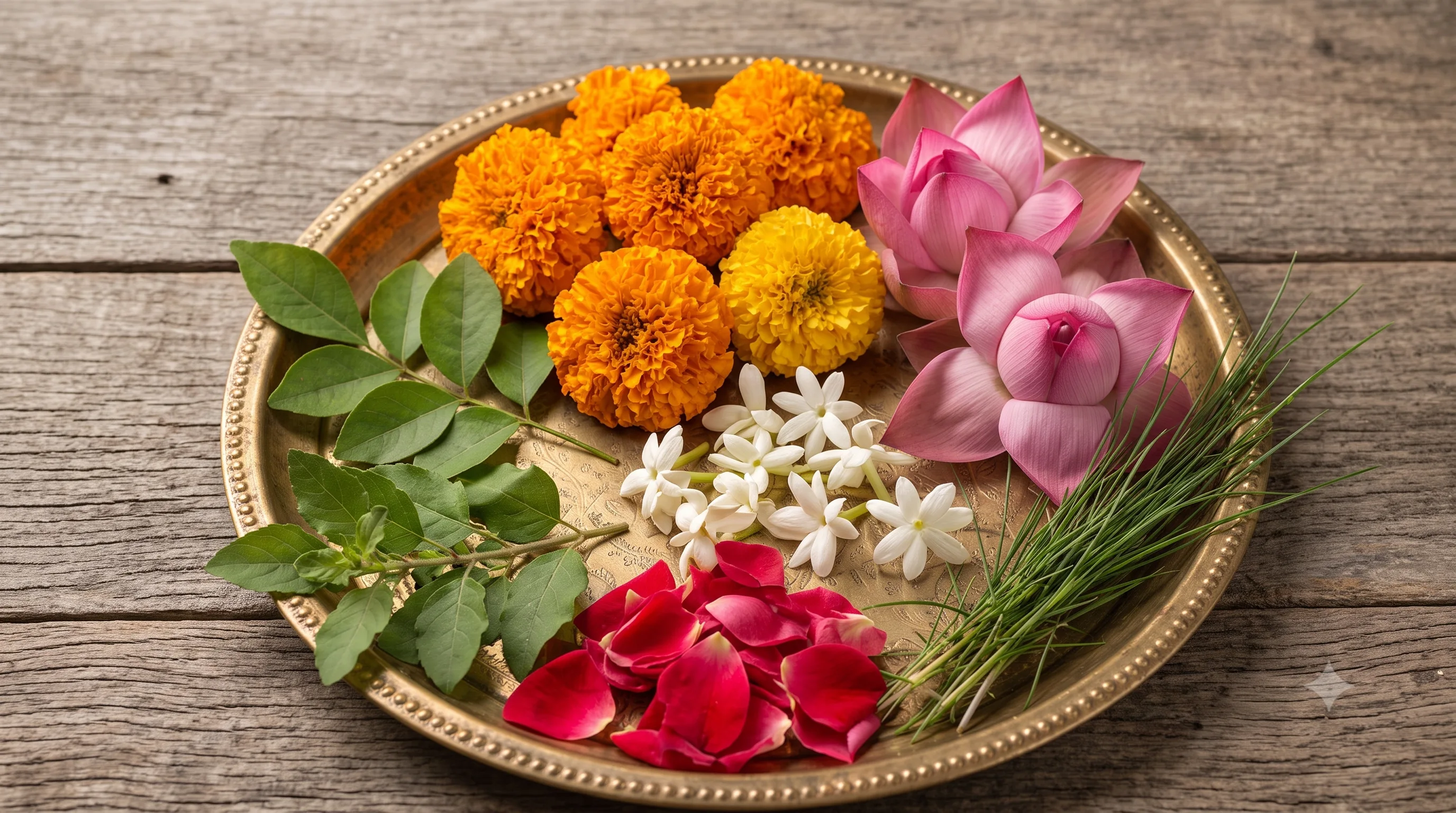
Every flower and leaf offered in worship is chosen with intention — some simply for their beauty and fragrance, others reserved for a single deity or a single day in the year. This guide walks through the twenty-one flowers and leaves in Avyani's Master Samagri Catalogue: what each one is, what the texts actually say about it, and how to buy, offer and set it aside with care.
Flowers (पुष्प) and leaves (पत्र) are two of the five classical offerings of the Panchopachara method described in our Daily Worship guide. Most are offered simply because they are fresh and beautiful. A few carry a meaning tied to one deity, and a very small number are traditionally set aside.
Where this guide says scripture, it names a text and verse you can check. Where it says tradition or regional practice, the custom is real and widely followed but has no single locator, and families differ. Where yours differs from anything here, yours is the one to keep.
The Leaves the Texts Name
Bilva patra (बिल्व पत्र, Aegle marmelos) is central to Rudrabhishek and to Shiva worship generally — see our Shiva Rituals guide. The Shiva Purana calls the bilva the symbol of Shiva, adored even by the gods, and places every holy centre at its root (Vidyeshvara Samhita 22.22–23).
Notice what that chapter praises: the tree, and worship at its root. The familiar reading of the three-lobed leaf as Shiva's three eyes and trident comes from the Bilvashtakam, a stotra traditionally ascribed to Adi Shankaracharya — household practice, not a rule from the Purana.
Durva grass (दूर्वा, Cynodon dactylon) belongs to Ganesha — see our Ganapati Rituals guide. The Ganapati Atharvashirsha says one who worships with durva sprouts becomes the equal of Kubera (v. 13). The word is durvankura, the tender growing tip, which is why fresh young shoots rather than coarse grass are offered. Tying them in bunches of twenty-one is paddhati custom and varies.
Tulsi (तुलसी पत्र, Ocimum tenuiflorum) is the leaf of Vishnu worship, throughout our Vishnu Rituals guide. The association is carried by Vaishnava Puranic literature and every major paddhati — too broad a claim to pin to one verse, so we do not pretend otherwise. Many households will not pluck tulsi after sunset or on Ekadashi; observance varies by region.
What Tradition Sets Aside
Two exclusions have a genuine textual basis. In the Shiva Purana, the ketaki flower (Pandanus odorifer, kewda) bears false witness for Brahma, and Shiva tells it: "you are roguish and deceitful… Hereafter I have no desire to include you in my worship" (Vidyeshvara Samhita 8.15–16). The same chapter then softens it: his attendants may wear it, and it may decorate the canopy above his image (8.19–21). The bar is on offering, not on presence.
The second is tulsi in Ganesha's worship, excluded after the mutual curses related in the Brahmavaivarta Purana, Ganapati Khanda 46. Other avoidance lists circulate widely without any locator and often contradict one another; where we cannot name a text, we say so.
Everyday Flowers
Marigold (गेंदा, Tagetes) is the most-used ritual flower in India today and the backbone of most garlands and torans. The genus is native to the Americas and reached India with sixteenth-century European trade, so it is not the flower classical Sanskrit sources name. That takes nothing from its place in worship — it only means "traditional" and "ancient" are not always the same word.
Loose mixed flowers are scattered by hand for pushpanjali and archana, and a flower garland is placed on the image for festival worship. Jasmine, the staple garland flower of the South, and rose carry no restriction at all.
Hibiscus (जपाकुसुम) is the exception: very nearly scentless, and offered for its colour. Deep red hibiscus belongs above all to Devi and to Kali, most strongly in Bengal and eastern India — see our Devi Rituals guide — and is commonly given to Ganesha too. Its Sanskrit name opens the Surya dhyana verse japakusumasankasham, a simile for the rising sun rather than a rule about offerings.
Flowers Kept for a Particular Deity
The lotus (कमल) is seasonal, scarce out of season, and associated with Devi and Lakshmi — see our Lakshmi Rituals guide. A single bloom is a perfectly good offering. Aparajita (अपराजिता, Clitoria ternatea), "the unconquered", is used in Devi worship and carries that sense into Durga observance in eastern India — regional practice, not scriptural requirement.
Champa (चंपा) covers two different trees. Sanskrit campaka denotes Magnolia champaca, the golden champa; what is sold as champa in Indian markets today is usually Plumeria, a genus native to the American tropics. Both are offered and neither is wrong — but where a paddhati specifies campaka, it means the magnolia.
Datura (धतूरा) is offered to Shiva alongside arka and bilva, and its place there is long-standing. It is also seriously poisonous — which the tradition takes for granted and a supplier should not.
Datura is poisonous. It is a ritual offering only.
- Every part — flower, leaf, seed pod — contains tropane alkaloids including atropine and scopolamine. Swallowing any part can cause delirium, rapid heartbeat, seizures and coma, with onset inside an hour. Children are far more susceptible than adults.
- Keep it away from naivedya, prasad and charanamrit, and out of reach of children. Wash hands after handling.
- If any part is swallowed, seek emergency medical care at once and say datura was involved. Do not induce vomiting without medical direction.
Leaves for Rite and Season
Kush or darbha (कुश/दर्भ) is the ritual grass of Vedic rite, and one of the few dry, storable items here. It is mandatory in Shraddha and Pitru Karma — spread as a seat for the ancestors, and twisted into the pavitri ring worn on the right ring finger. See our Shraddha and Pitru Karma guide.
Mango leaves are strung as a toran and tied around the mouth of the kalash; choose mature leaves, as young red-tinged ones wilt within hours. Betel leaves (पान) are offered with supari as tambula, and as a mark of respect to the priest.
Four leaves belong to particular observances. Fresh turmeric plant is tied around the pot at Pongal and Makar Sankranti, a South Indian custom rather than a pan-Indian one — see our Surya Rituals guide. Vat or banyan leaves belong to the Vat Savitri Vrat of North and Western India. Neem goes with Shitala and with Ugadi; peepal appears in vrat observance and Navagraha remedies.
Ashoka leaves are worth buying knowingly. True ashoka is Saraca asoca, IUCN Vulnerable, with compound leaves and orange-red flowers. What is planted and sold far more often is Polyalthia longifolia, the false ashoka, with simple leaves and green flowers — published work on the Asoca crude drug found counterfeit material in most market samples.
Choosing, Offering and Setting Aside
Most of what makes a good offering is ordinary care, not rarity. A modest handful of fresh flowers beats a large quantity of tired ones. Bulk market flowers are sometimes surface-dyed or carry pesticide residue, so rinse them gently in plain water — never soap. Leaves are best bought on the day, and keep better under a damp cloth in the shade than in a sealed plastic bag, which sweats and blackens them.
Afterwards, nirmalya is set aside with respect rather than thrown out with the household rubbish. Strip out plastic thread, wire and foil first — that binding, not the flowers, is what pollutes a river or spoils a compost heap. Then compost it, or return it under a tree at home.
Flowers and Leaves at a Glance
Mandatory and optional follow Avyani's catalogue for supply and kit-building; a priest may ask for more or less.
| Item | Hindi | Botanical name | Mandatory / Optional |
|---|---|---|---|
| Marigold Flowers | गेंदा पुष्प | Tagetes erecta | Mandatory |
| Loose Mixed Flowers | मिश्रित पुष्प | Mixed | Mandatory |
| Flower Garland | पुष्प माला | Mixed | Mandatory |
| Hibiscus Flower | जपाकुसुम | Hibiscus rosa- |
Optional |
| Jasmine Flowers | चमेली पुष्प | Jasminum sambac | Optional |
| Rose Flowers | गुलाब पुष्प | Rosa spp. | Optional |
| Lotus Flower | कमल पुष्प | Nelumbo nuci |
Optional · seasonal |
| Aparajita Flower | अपराजिता पुष्प | Clitoria ternatea | Optional |
| Champa Flower | चंपा पुष्प | Magnolia champaca; market champa is often Plumeria | Optional |
| Datura Flower | धतूरा पुष्प | Datura metel — poison |
Optional |
| Bilva Patra | बिल्व पत्र | Aegle marmelos | Mandatory · seasonal |
| Durva Grass | दूर्वा | Cynodon dactylon | Mandatory |
| Tulsi Leaves | तुलसी पत्र | Ocimum tenui |
Mandatory |
| Kush Grass (Darbha) | कुश/दर्भ | Desmo |
Mandatory · dry item |
| Mango Leaves (Toran) | आम के पत्ते | Mangi |
Mandatory |
| Betel Leaves (Paan) | पान का पत्ता | Piper betle | Mandatory |
| Ashoka Leaves | अशोक पत्ते | Saraca asoca; often substituted by Poly |
Optional |
| Neem Leaves | नीम के पत्ते | Azadi |
Optional |
| Peepal Leaves | पीपल के पत्ते | Ficus religi |
Optional |
| Vat (Banyan) Leaves | वट के पत्ते | Ficus benghal |
Optional |
| Turmeric Plant (Fresh) | हल्दी का पौधा | Curcuma longa | Optional · regional |
See also our Understanding Samagri guide and the full Samagri Catalogue. A qualified priest can advise on what a particular occasion and family tradition require.
Sources
- Shiva Purana, Vidyeshvara Samhita 22.22–29 (greatness of the bilva) and 8.15–21 (the ketaka flower) — ch. 22, ch. 8.
- Ganapati Atharvashirsha v. 13 — Sanskrit text with translation.
- Brahmavaivarta Purana, Ganapati Khanda 46; trans. Rajendra Nath Sen, Sacred Books of the Hindus (1922).
- Bilvashtakam, traditionally ascribed to Adi Shankaracharya; preserved in stotra collections.
- Datura toxicity — PMID 35903511, PMID 23377485.
- Saraca asoca and Polyalthia longifolia — fingerprinting study; IUCN Red List assessment.
- Temple floral waste and composting — doi:10.1007/s11356-018-1259-0.
- Item names, units and mandatory flags — Avyani Master Samagri Catalogue v1.
Scriptural references are cited to published translations. Where a locator could not be verified, the statement is given as tradition or regional practice rather than scripture. Nothing here is medical advice.