


Somnath Jyotirlinga
Somnath Jyotirlinga (सोमनाथ ज्योतिर्लिंग) — Jyotirlinga (the first Jyotirlinga)
- Gujarat
- Easy (Sugam)
- PlacePrabhas Patan, Veraval Taluka, Gir Somnath District, Gujarat
- Presiding deityShiva
Traveller Note: Mobile phones, cameras and leather articles are not permitted inside the temple complex; cloakroom facilities are available.
Scriptural and Historical Significance
- Puranic Reference: Described in the Shiva Purana (Kotirudra Samhita) and in the Prabhas Khand of the Skanda Purana. According to Puranic legend, Chandradev (Soma), afflicted with a wasting disease by the curse of Daksha Prajapati, worshipped Shiva here and was freed from the curse; hence the site came to be called "Somnath" (Lord of Soma).
- History of Invasions: In 1026 CE Mahmud of Ghazni destroyed and plundered the temple; it was subsequently rebuilt by the Chalukya (Solanki) ruler Bhimadeva I and, around 1169 CE, by Kumarapala. The temple was damaged again by the army of Alauddin Khilji in 1299 CE and later during the reign of Aurangzeb (around 1706 CE).
- Contribution of Ahilyabai: In 1783 CE Maharani Ahilyabai Holkar of Indore built a separate Shiva temple near the original site, known today as the "Ahilyabai Temple" or "Old Somnath".
- Present Temple: After Independence, reconstruction began in November 1947 at the resolve of Sardar Vallabhbhai Patel; on 11 May 1951 President Dr. Rajendra Prasad performed the prana-pratishtha (consecration) of the Jyotirlinga. The temple is administered by the Shree Somnath Trust.
- The Prabhas region is also held sacred as the Triveni Sangam (confluence) of the Hiran, Kapila and Saraswati rivers; according to tradition, Bhagwan Shri Krishna also relinquished His mortal form in this region.
Key Features, Architecture, Rituals and Aarti
- Style: The present temple is a "Kailash Mahameru Prasad" in the Chalukya (Solanki / Maru-Gurjara) style, designed by the architect Prabhashankar Sompura; the shikhara (temple spire) rises approx. 150 feet and is crowned with a kalash (finial) and a dhwajadand (flagstaff).
- Garbhagriha: The structure proceeds in sequence from garbhagriha (sanctum) to sabhamandapa (assembly hall) and nrityamandapa (dance hall); in this sea-facing temple the Jyotirlinga receives daily abhishek (ritual bathing) and shringar (adornment).
- Baan Stambh: The Baan Stambh (Arrow Pillar), facing the seashore, bears a Sanskrit inscription stating that there is no landmass in a straight line from this point to the South Pole.
- Aarti: Three principal aartis are performed daily (at approx. 7:00 AM, 12:00 noon and 7:00 PM). A sound-and-light programme is held in the temple complex in the evening.
Best Time to Visit, Timings and Festivals
- Best Season: October to March; humidity on the coast is high in summer.
- Daily Darshan: Approx. 6:00 AM to 10:00 PM (Timings are subject to change; please confirm with the temple trust before travelling.)
- Major Festivals: Mahashivratri, the entire Shravan month (July–August), especially Shravan Mondays, and the traditional fair held on Kartik Purnima.
How to Reach
- By Air: Keshod Airport approx. 55 km; Diu Airport approx. 85 km; Rajkot (Hirasar) International Airport approx. 200 km.
- By Rail: Somnath Railway Station approx. 1–2 km; Veraval Junction approx. 6 km.
- By Road: Regular state transport and private buses are available from Junagadh (approx. 90 km), Rajkot, Ahmedabad (approx. 400 km) and Diu.
Nearby Spiritual and Other Places
- Triveni Sangam Ghat: Confluence of the Hiran, Kapila and Saraswati — approx. 1.5 km.
- Golok Dham (Dehotsarg Tirth): According to tradition, the site where Shri Krishna relinquished His mortal form — approx. 1.5–2 km.
- Bhalka Tirth: Where it is believed the arrow of the hunter Jara struck Shri Krishna — approx. 5 km.
- Ahilyabai (Old Somnath) Temple: Approx. 0.5 km.
- Girnar Hill, Junagadh: A mountain of Jain and Hindu pilgrimage sites — approx. 90 km.
- Diu: Gangeshwar Mahadev (Shivalingas on the seashore) — approx. 85 km.
Photos
-
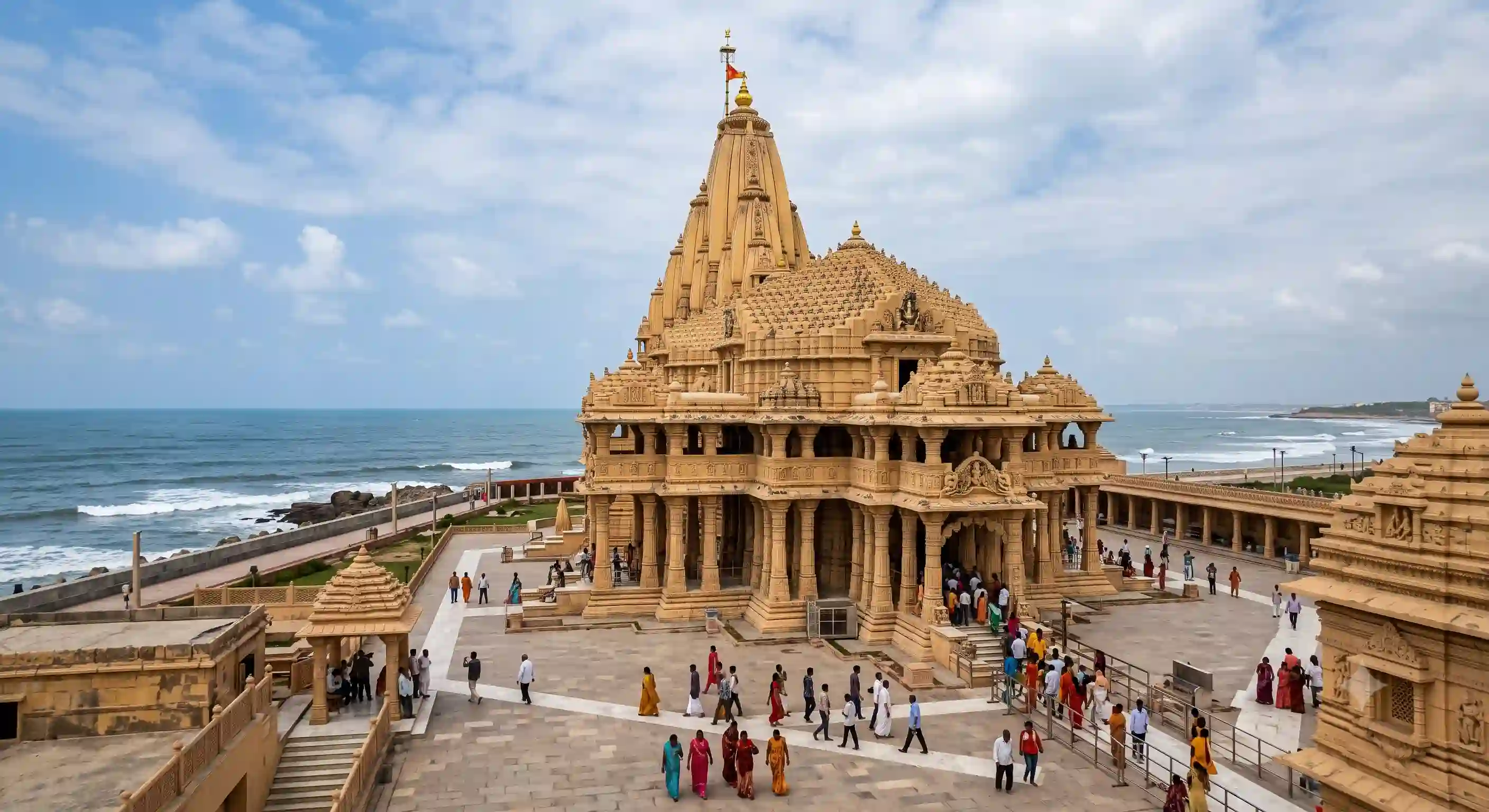
Somnath Jyotirlinga
Sources 1
- Major Temples, Tirthas & Dhams of India (Avyani project reference, EN + HI editions, Sep 2026)
Where a tradition is told differently from region to region or from one sampradaya to another, the tellings are given side by side.
Darshan timings, portal dates, registration rules and distances are approximate and change from time to time; please confirm with the official notices of the temple trust or administration before travelling.