


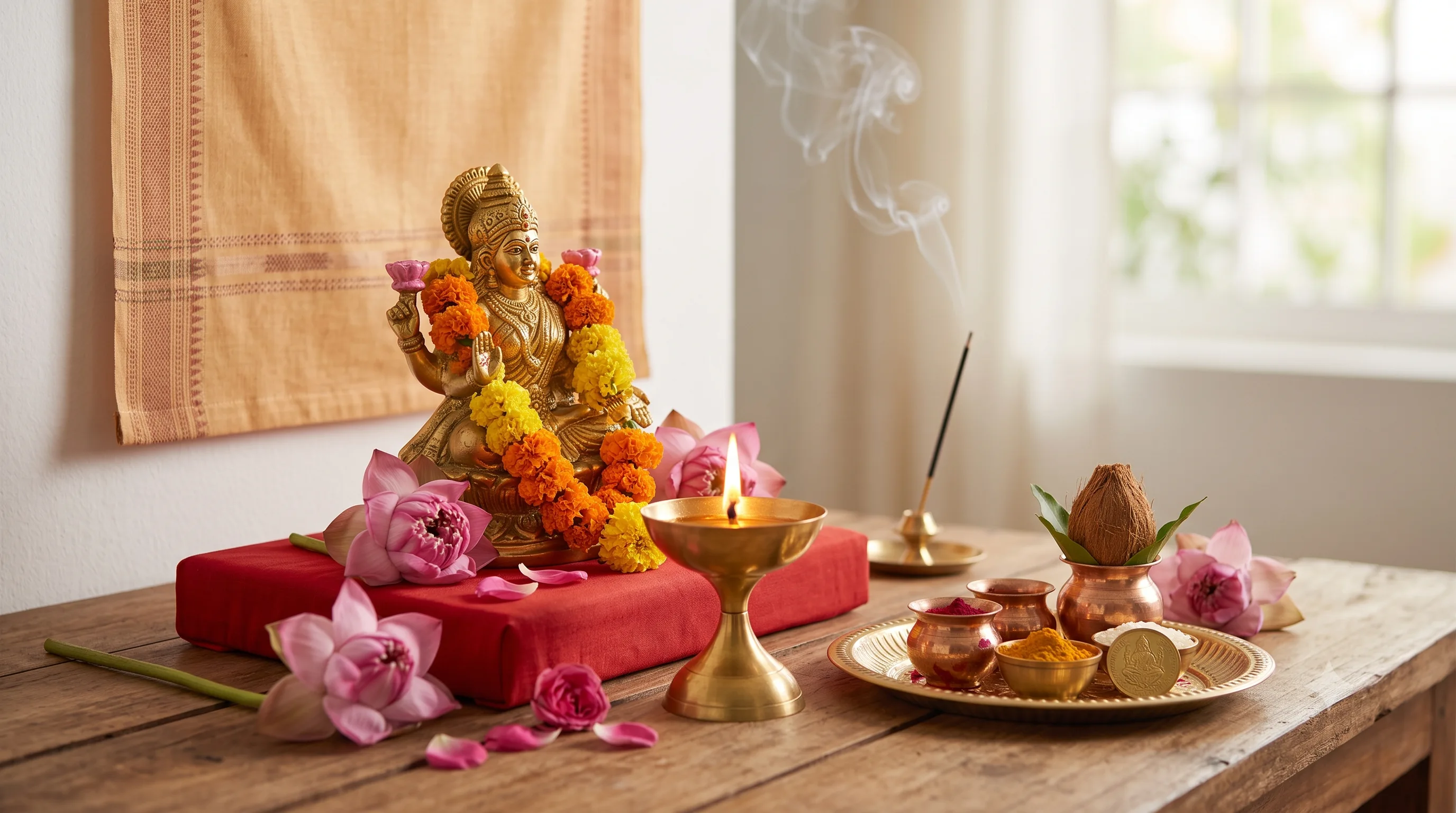
Fifteen Lakshmi rituals, from the lamplit worship of Diwali night to the South Indian vrat of Varalakshmi. This guide sets out where the tradition's oldest Lakshmi hymn actually sits, how the forms differ, and what the catalogue's wealth language does and does not mean.
Lakshmi (लक्ष्मी), goddess of wealth, fortune and abundance, is worshipped in her own right and frequently alongside Kubera, treasurer of the gods, and Ganesha. Avyani's Master Puja & Ritual Catalogue records fifteen Lakshmi rituals, distinct from — though overlapping with — the broader Devi Rituals category.
This is an overview, not a manual. Where it says scripture, it names a text you can check; where it says tradition or regional practice, the custom is real and widely followed but has no single locator.
On the wealth language in this guide. Nearly every ritual here is described by tradition in terms of wealth, gain or financial security. Those are the intentions the tradition assigns, recorded as such. They are not outcomes Avyani predicts or guarantees, and nothing here is financial advice or a substitute for it.
The Sri Sukta
The oldest Lakshmi hymn in regular use is the Sri Sukta, and its position is worth stating precisely. It is not a hymn of the Rigveda proper: it belongs to the khila, the supplementary material appended after the fifth mandala, and survives in the Bashkala recension rather than in every textual tradition.
That still makes it very old — the khilani belong to the Vedic mantra period — and it remains the text recited at most formal Lakshmi worship. Calling it "a Rigvedic hymn" is loose; calling it a Rigvedic khila is right.
Diwali, Dhanteras and the Autumn Cycle
Diwali Lakshmi Puja, performed at dusk with rows of lamps and the account books opened for blessing, is among the most widely observed rituals in the Hindu calendar. It is preceded by Dhanteras Puja, traditionally associated with buying gold or new utensils, and answered later in the year by Kojagiri Lakshmi Puja on the full moon after Navratri — the night when, tradition says, Lakshmi asks who is awake.
Akshaya Tritiya Puja falls in spring and carries the sense of the imperishable: what is begun or given on that day is held to not diminish. All four are household observances that need no priest, though many families engage one for the Diwali puja.
Lakshmi with Kubera and Ganesha
Lakshmi is rarely worshipped entirely alone. Kubera Puja addresses the guardian of treasure directly; Lakshmi Kubera Puja and its fire form, Lakshmi Kubera Homam, join the two. Mahalakshmi Puja is the fuller, formal worship of the goddess in her own right, and Ashtalakshmi Puja addresses her eight forms — Adi, Dhanya, Dhairya, Gaja, Santana, Vijaya, Vidya and Dhana Lakshmi — which between them cover far more than money.
That last point is worth pausing on: the eight Lakshmis include grain, courage, progeny, learning and victory. The tradition's idea of shri is closer to flourishing than to currency.
Yantra, Stotra and Vrat
Shri Yantra Puja worships the goddess through the geometric diagram described in our Jewellery and Sacred Items guide; a yantra is consecrated and installed rather than displayed, and a priest is the right person to advise on that.
Kanakadhara Puja takes its name from the Kanakadhara Stotram, traditionally ascribed to Adi Shankaracharya and associated with the story of a shower of golden amalaka fruit granted to a poor household. Vaibhava Lakshmi and Dhan Lakshmi Puja are simple household forms.
Regional practice. Varalakshmi Vratam is kept by married women on the Friday before the full moon of Shravana, chiefly in Tamil Nadu, Karnataka, Andhra Pradesh and Telangana, and is among the most important Lakshmi observances of the south. It has no close northern equivalent.
What the Puja Uses
Lakshmi worship draws on lotus above all — see our Flowers and Leaves guide — along with a silver or copper coin placed in the kalash, described in Kalash and Utensils, and the lamps of our Incense, Camphor, Oils and Ghee guide.
Lakshmi Rituals at a Glance
Durations are typical planning ranges. "Traditionally for" records the intention the tradition assigns — not an outcome Avyani predicts or guarantees.
| Ritual | Tradi |
Typical duration | Priest advised |
|---|---|---|---|
| Maha | Wealth and abundance | 1–1.5 hours | Yes |
| Diwali Lakshmi Puja | Wealth; the new ledger year | 1–1.5 hours | Yes |
| Dhanteras Puja | Health, wealth, new purchases | 30–45 mins | No |
| Kojagiri Lakshmi Puja | Wealth and wellbeing | 1 hour | No |
| Akshaya Tritiya Puja | Lasting plenty; new starts | 30–45 mins | No |
| Dhan Lakshmi Puja | Money and stability | 30–45 mins | No |
| Vaib | Wealth and family welfare | 45–60 mins | No |
| Kanaka | Sudden gain; relief from want | 30–45 mins | No |
| Kubera Puja | Wealth kept and guarded | 30–45 mins | No |
| Vara | Family welfare; a southern vrat | 2–3 hours | No |
| Lakshmi Kubera Puja | Wealth gained and kept | 1 hour | Yes |
| Lakshmi Kubera Homam | Wealth; business ventures | 2 hours | Yes |
| Shri Yantra Puja | Wealth and inner growth | 1–1.5 hours | Yes |
| Ashta | The eight forms of shri | 1 hour | Yes |
| Financial Prosperity Puja | Business growth | 1 hour | Yes |
For the samagri these rituals use, see the Samagri Catalogue and our Understanding Samagri guide.
Sources
- Sri Sukta — a Rigvedic khila appended after the fifth mandala, preserved in the Bashkala recension; part of the Vedic mantra-period material rather than of the Rigveda Samhita proper.
- Kanakadhara Stotram — traditionally ascribed to Adi Shankaracharya; the attribution is traditional and is described as such.
- The eight forms of Ashtalakshmi — established devotional tradition; lists vary slightly between sources.
- Varalakshmi Vratam as a southern observance of Shravana — documented regional practice.
- Ritual names, durations and priest-advised flags — Avyani Master Puja & Ritual Catalogue. Durations are planning ranges, not prescriptions.
Where a scriptural locator could not be verified, the statement is given as tradition or regional practice rather than scripture. Stated purposes are the intentions the tradition assigns, not outcomes Avyani predicts. Nothing here is financial advice.