


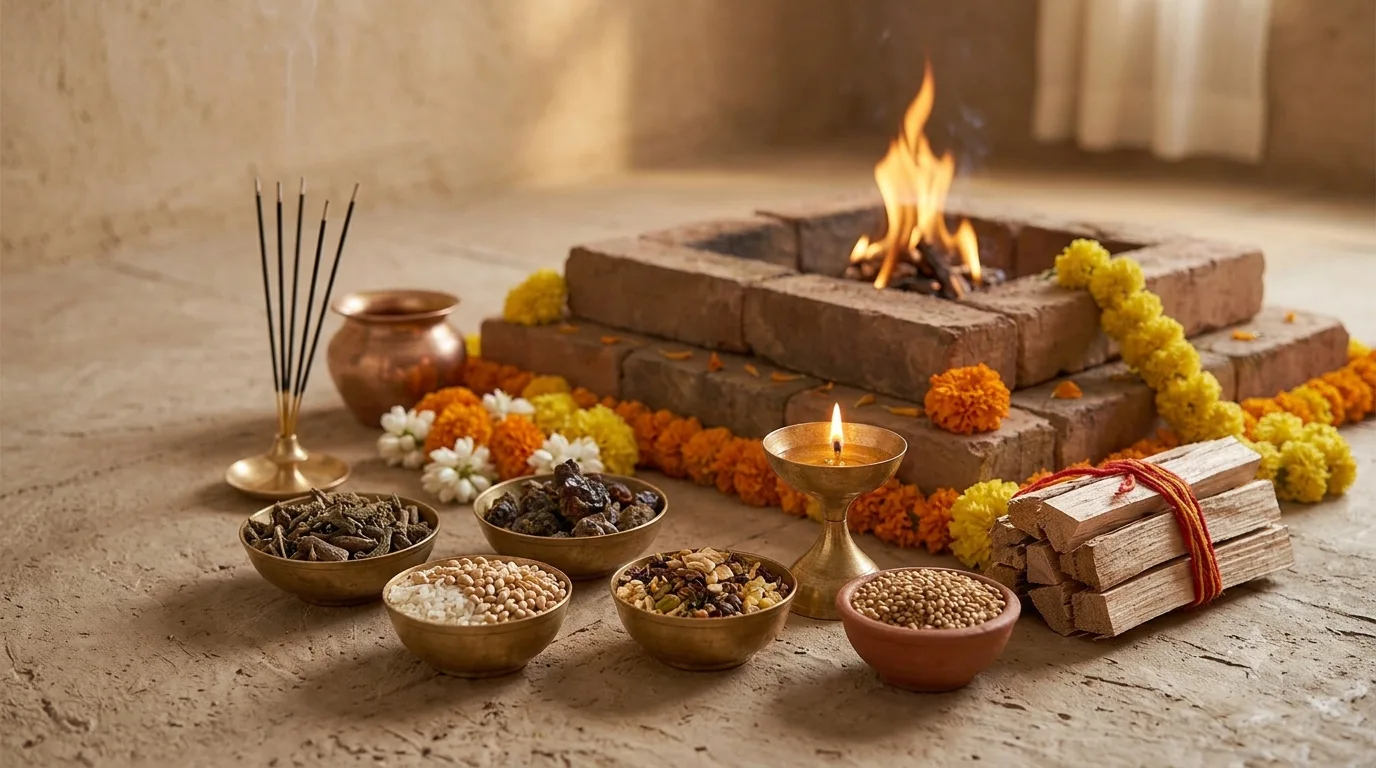
A practical guide to the fire pit, fuel, samidha and offerings used in a home or temple havan, drawn from Avyani's Master Samagri Catalogue.
A havan or homam — the offering of substances into a consecrated fire — sits at the centre of many of the rituals in our Puja Catalogue, from a simple Ganapati Homam to the elaborate Rudra sequence. The materials below, drawn from Avyani's Master Samagri Catalogue, cover what most home and temple fire rituals require.
The Fire Pit and Tools
A Havan Kund — a consecrated pit or portable brass vessel — holds the fire itself. Offerings are made using a Sruk-Sruva, a paired set of long-handled spoons reserved specifically for havan use and not for general kitchen purposes.
Fuel: Wood and Samidha
The fire is fed with samidha — sacred wood sticks — traditionally from specific trees according to the ritual and deity invoked: mango and peepal wood are widely used, while bilva wood is associated with Shiva worship, palash with certain Vedic rites, and shami wood with Navagraha and Shani-related rituals. Dried cow dung cakes (kande) are a traditional and widely available fuel, particularly for larger or longer havans.
The Havan Samagri Mix and Offerings
A prepared Havan Samagri mix — typically a blend of dried herbs, grains and aromatic woods — forms the base offering poured or dropped into the fire with each mantra. This is enriched with cow ghee, which both feeds the fire and is itself considered a purifying offering, and jaggery, offered for sweetness and completeness. Fragrant resins — guggal and loban (benzoin) — are added for their purifying smoke, especially in longer or more elaborate homams. For the complete itemised list of havan samagri, wood and fuel with mandatory/optional status, see our Havan Samagri, Wood and Fuel guide.
Grains Offered in the Fire
Black sesame seeds (til), barley (jau) and whole rice (akshat) are among the most commonly offered grains, each tied to specific mantras and stages of the ritual. A Navdhanya (nine-grain) mix is used in more elaborate or Navagraha-related fire rituals.
After the Havan
Once the fire has been allowed to burn down and cool completely, the resulting ash (bhasma) is collected respectfully — see our guide to Caring for Puja Samagri at Home for how this and other materials are traditionally handled afterward.
A Note on Guidance
Because a havan involves an open flame and specific sequencing of mantras and offerings, most households arrange for a qualified priest to lead all but the simplest daily fire offerings (such as Agnihotra). A priest can also confirm which wood and materials are called for by your family's specific tradition.