


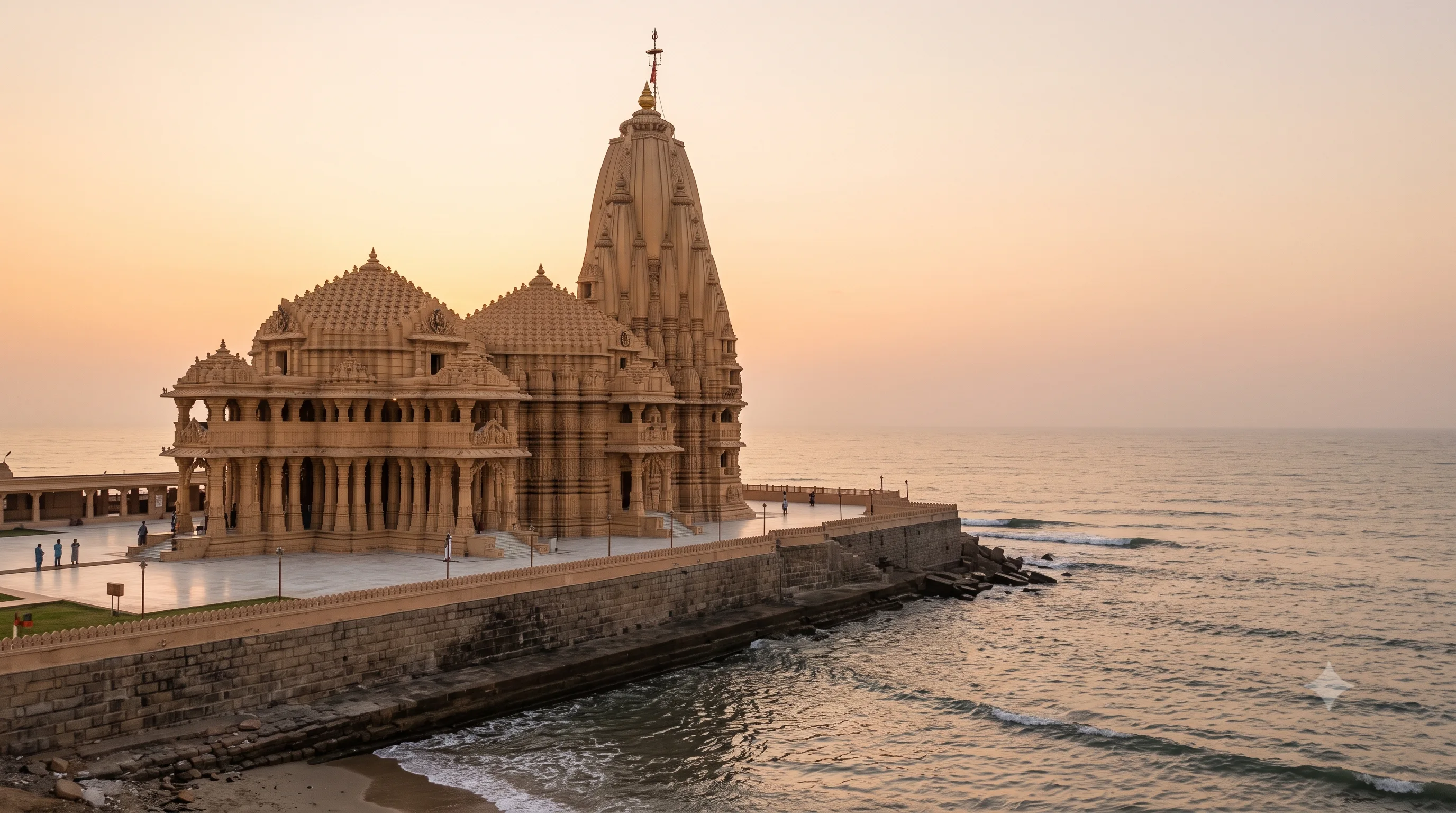
A historic Jyotirlinga temple on the coast of Gujarat, rebuilt many times through the centuries and standing today as a symbol of unbroken devotion.
On the Arabian Sea coast at Prabhas Patan, near Veraval in Gujarat, stands the Somnath Temple, dedicated to Shiva as Somnath, "Lord of the Moon," and counted first among the twelve Jyotirlingas. Few temples in India carry a history as marked by destruction and rebuilding, and few stand today as clear a symbol of continuity.
The Presiding Deity
The presiding deity is Somnath, Shiva worshipped in the form of a Jyotirlinga. The name itself, Soma being one of the names of the Moon, connects the shrine to a well-known Puranic legend describing its founding.
Spiritual and Scriptural Significance
According to the Prabhas Khanda of the Skanda Purana, the Moon god Chandra, cursed by his father-in-law Daksha, built a golden temple to Shiva at this site to be freed from the curse. This is a traditional Puranic narrative, not a historical record, but it is central to why the site has been regarded as sacred since antiquity — the temple and the wider Prabhas region appear in several Puranic texts. Somnath's place among the twelve Jyotirlingas is recorded in the traditional Dwadash Jyotirlinga Stotram, popularly attributed to Adi Shankaracharya:
सौराष्ट्रे सोमनाथं च श्रीशैले मल्लिकार्जुनम् ।
saurāṣṭre somanāthaṃ ca śrīśaile mallikārjunam
"In Saurashtra, Somnath; and at Srishailam, Mallikarjuna" — the opening line of the stotra, naming Somnath as the first of the twelve Jyotirlingas.
A History of Destruction and Renewal
The temple's documented history spans nearly a thousand years of repeated destruction and reconstruction. It was first sacked by Mahmud of Ghazni in 1025–26, and was destroyed and rebuilt again after later attacks, including in 1297, 1394 and 1706 under Aurangzeb. In 1783, the Maratha queen Ahilyabai Holkar built a modest new temple nearby. The present temple's reconstruction began after India's independence: Sardar Vallabhbhai Patel laid its foundation stone in November 1947, and the temple as it stands today was completed in May 1951, some years after his death.
Traditions and Worship
Daily worship follows the pattern common to Shiva temples, including morning and evening aartis, with Rudrabhishek, described in our Abhishekam and Worship Methods guide, among the offerings devotees commonly make here, alongside the broader worship practices in our Shiva Rituals guide. In the evenings, the temple hosts a sound-and-light presentation recounting its history, drawing both pilgrims and visitors.
What a Devotee Should Know Before Visiting
The temple sits directly on the coast, and the sea wall and promenade are part of the visiting experience — comfortable footwear is worth bringing given the walking involved. As with most major temples, mobile phones and cameras are often restricted in the inner sanctum; it is worth checking current rules before arriving. The temple is well suited to a visit combined with other sites in the region, including Dwarka.
Location and Access
Somnath Temple is located at Prabhas Patan, near Veraval, on the Saurashtra coast of Gujarat. The nearest airports are at Diu and Rajkot, and the town is connected by rail to major Gujarati cities.