


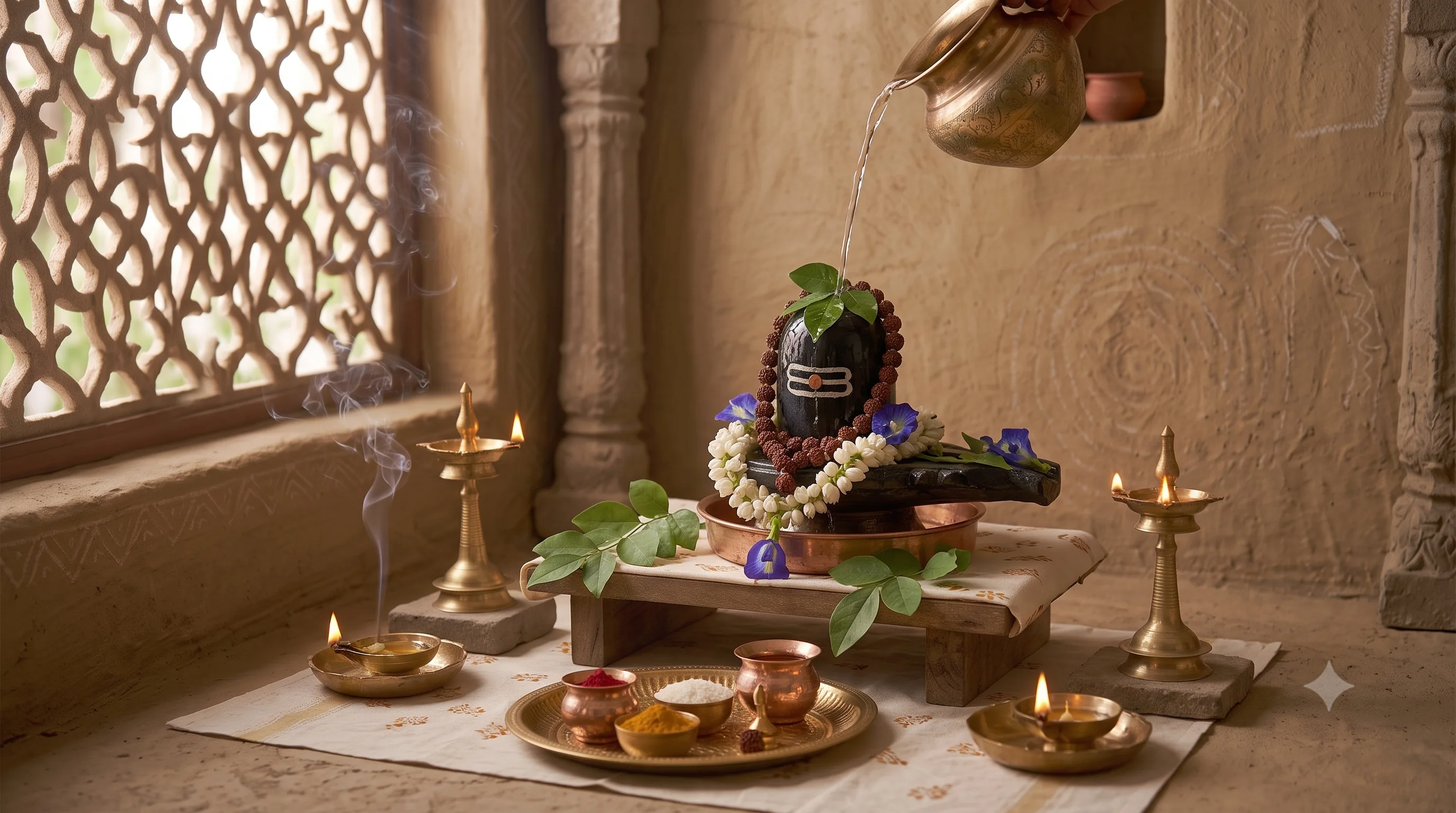
Thirty Shiva rituals, from a simple daily offering of water and bilva leaves to the grand, multi-day Rudra recitations of temple tradition, drawn from Avyani's Master Puja & Ritual Catalogue.
Shiva is worshipped across India in forms ranging from the simplest offering of water and bilva leaves to grand, multi-day recitations of the Rudram performed by teams of priests. Avyani's Master Puja & Ritual Catalogue documents thirty distinct Shiva rituals, spanning the Shaiva and Agama traditions, temple practice, and household devotion.
Everyday Devotion
A simple Shiva Puja — water, bilva leaves and mantra offered to the linga — takes as little as thirty minutes and needs no priest. Bilva Archana, the ritual offering of 108 or 1008 bael leaves, and Panchakshari Jaap — the repetition of Shiva's five-syllable mantra — are similarly accessible daily or weekly practices:
ॐ नमः शिवाय
Om Namah Shivaya — "Om, salutations to Shiva" — draws its name (Panchakshari, "five syllables") from na-mah-shi-va-ya, the five sounds at its heart. It needs no particular occasion; many recite it simply as a steady point of return through the day. Somvar Vrat, a Monday fast and worship, is widely observed by householders across regions.
Abhishekam and the Rudra Traditions
Rudrabhishek — the ritual bathing of the Shiva linga while the Rudram-Chamakam is recited — is the classical form of Shiva worship and forms the basis of a graded sequence of increasing scale: Ekadash Rudrabhishek (eleven repetitions), Laghu Rudra (121 recitations), Maha Rudra (eleven Laghu Rudras together), and, rarely, Ati Rudra — the most elaborate Rudra yajna performed only on exceptional occasions and requiring many days and priests. Panchamrit Abhishekam, bathing the deity in five sacred substances, is a gentler and very widely performed variant.
Mahamrityunjaya and Rituals of Healing
The Mahamrityunjaya Mantra, addressed to Shiva as conqueror of death, is central to two related rituals: the Mahamrityunjaya Jaap, a repeated personal recitation, and the more elaborate Mahamrityunjaya Homam, a fire ritual usually sought for health, recovery and longevity.
Pradosh, Shivaratri and the Festival Calendar
Pradosh Puja, performed at twilight on the thirteenth lunar day, and its grander temple counterpart Pradoshotsavam, are regular fixtures of the Shaiva calendar. Maha Shivaratri Puja — an all-night vigil with worship at four watches of the night — is the most significant annual Shiva observance nationwide. Regional and sampradaya forms include Kedar Gauri Vrat, associated with marital harmony, and temple-specific traditions such as the Amarnath Yatra Puja and Sri Shailam Mallikarjuna Puja.
Forms and Temple Traditions
Shiva is worshipped through many iconographic forms: Nataraja, the Cosmic Dancer, especially revered by performing artists; Dakshinamurti, the primordial teacher; Kalabhairava, the fierce protector; Ardhanarishwara, the composite Shiva-Parvati form; and Vishwanath, as enshrined at Varanasi. Jyotirlinga Puja refers to worship performed at, or invoking, the twelve Jyotirlinga shrines distributed across the country.
Shiva Rituals at a Glance
| Ritual | Occasion / Purpose | Typical Duration | Priest Recommended |
|---|---|---|---|
| Shiva Puja | General worship, inner peace | 30-45 mins | No |
| Rudrabhishek | Peace, prosperity, dosha removal | 1.5-2 hours | Yes |
| Ekadash Rudrabhishek | Removal of eleven-fold afflictions | 4-6 hours | Yes |
| Laghu Rudra | Moderate remedial worship | 1 day | Yes |
| Maha Rudra | Major remedial & communal merit | 2-3 days | Yes |
| Ati Rudra | Supreme cosmic welfare ritual | 7-11 days | Yes |
| Mahamrityunjaya Homam | Longevity, healing, protection from death | 2-3 hours | Yes |
| Mahamrityunjaya Jaap | Healing & protection from untimely death | 30-60 mins | No |
| Panchamrit Abhishekam | Purification & devotion | 30-45 mins | No |
| Bilva Archana | Devotion & merit | 30-45 mins | No |
| Pradosh Puja | Removal of sins, prosperity | 1-1.5 hours | Yes |
| Somvar Vrat Puja | Fulfilment of wishes, marital harmony | 30-45 mins | No |
| Shivaratri Puja | Liberation, spiritual awakening | Full night | Yes |
| Lingodbhava Puja | Commemorating Shiva's manifestation | 1 hour | Yes |
| Jyotirlinga Puja | Darshan merit, liberation | 1-2 hours | Yes |
| Ardhanarishwara Puja | Balance of masculine & feminine energies | 1 hour | Yes |
| Kalabhairava Puja | Protection, justice, fear removal | 1 hour | Yes |
| Nataraja Puja | Cosmic rhythm, artistic success | 1-2 hours | Yes |
| Dakshinamurti Puja | Knowledge, wisdom, guru grace | 1 hour | Yes |
| Panchakshari Jaap | Universal spiritual merit | 20-30 mins | No |
| Shiva Purana Paath | Spiritual merit, knowledge of Shiva tattva | 7 days | Yes |
| Rudram Chamakam Parayana | Comprehensive worship & remedial merit | 1 hour | Yes |
| Pradoshotsavam | Temple-scale twilight worship | 2 hours | Yes |
| Kedar Gauri Vrat Puja | Marital harmony, prosperity | 1 hour | No |
| Rudra Homam | Removal of afflictions, purification | 1.5-2 hours | Yes |
| Shiva Sahasranama Archana | Comprehensive devotion & merit | 1-1.5 hours | Yes |
| Vishwanath Puja | Liberation, spiritual merit | 1 hour | Yes |
| Amarnath Yatra Puja | Pilgrimage merit, darshan | 1-2 hours | Yes |
| Sri Shailam Mallikarjuna Puja | Jyotirlinga worship | 1 hour | Yes |
| Rudrabhishekam with Ghee | Prosperity, nourishment, remedial merit | 1-1.5 hours | Yes |
Many Shiva rituals — particularly the Rudra sequence and elaborate homams — call for a qualified priest trained in the correct recitation. See our Samagri Catalogue for the materials commonly used in abhishekam.