


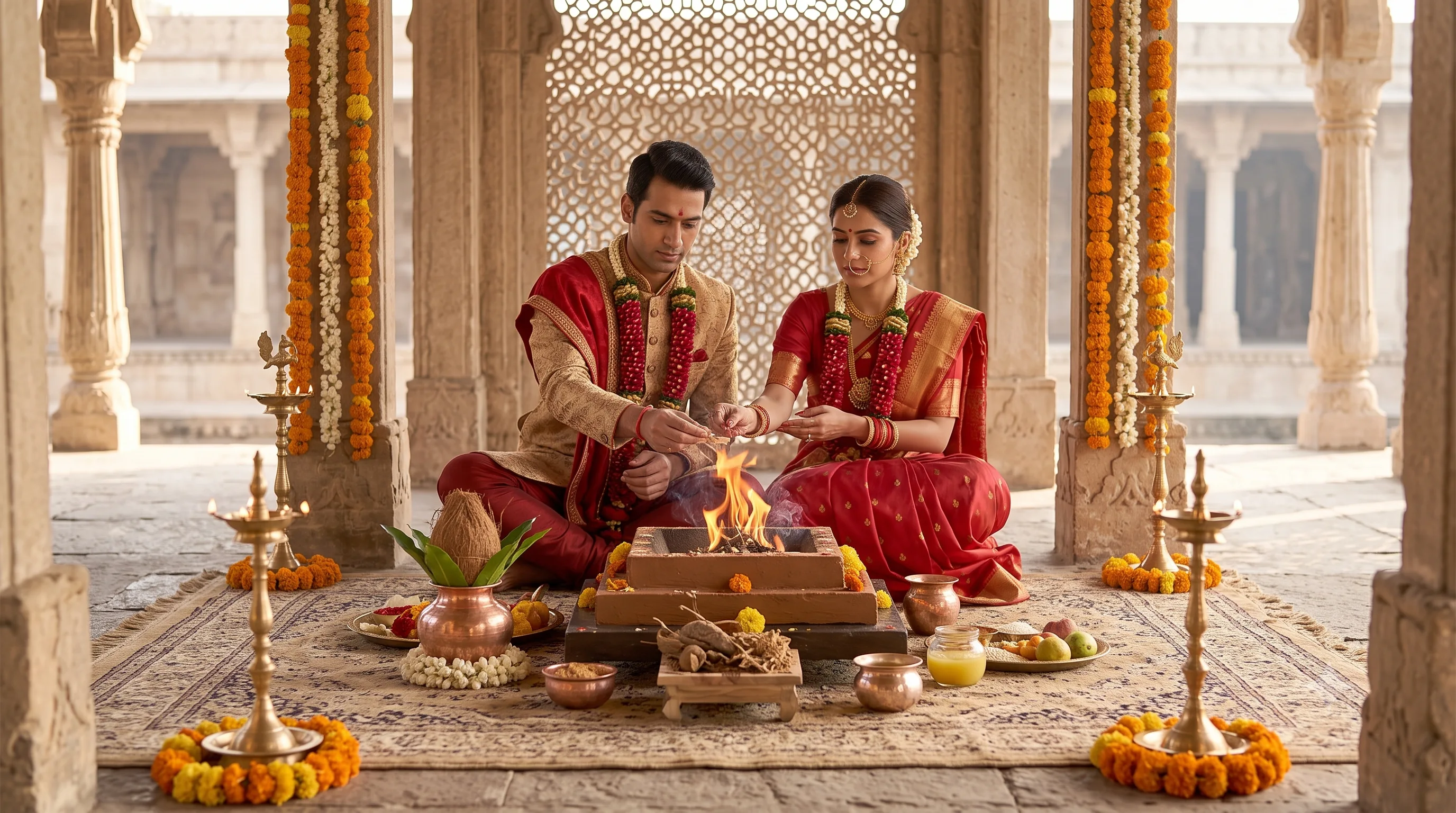
Twelve rituals spanning a Hindu wedding's full arc, from the first engagement ceremony through Kanyadaan and Saptapadi, drawn from Avyani's Master Puja & Ritual Catalogue.
Hindu marriage — Vivaha Sanskar (विवाह संस्कार) — is the fourteenth of the sixteen classical samskaras and, in most traditions, unfolds across several distinct ceremonies rather than a single event. Avyani's Master Puja & Ritual Catalogue records twelve rituals spanning the engagement, pre-wedding, wedding and early-marriage stages.
Before the Wedding
The process usually begins with an Engagement Puja or Ring Ceremony, formalising the agreement between families, known in South Indian traditions as Nishchitartham (निश्चितार्थम्). In the days before the wedding, Haldi (हल्दी) — the application of turmeric paste to the bride and groom — and Mehendi (मेहंदी) — the ceremonial application of henna, usually to the bride — are joyful, music-filled family occasions. Mangala Snanam, a ceremonial ritual bath, is performed just before the main ceremony in many traditions.
The Wedding Ceremony
The wedding itself centres on two rituals of particular significance: Kanyadaan (कन्यादान), in which the bride's father formally gives her in marriage, and Saptapadi (सप्तपदी), the seven steps taken together around the sacred fire (Agni), which formally and traditionally solemnises the marriage. These sit within the fuller Vivah Sanskar sequence, which varies in detail by region and family tradition but shares this same essential structure across virtually all of them.
Early Marriage and Pregnancy
Several rituals in this category extend beyond the wedding itself into early married life: Godh Bharai, a North Indian celebration of late pregnancy also recorded among the Samskaras as Simantonnayana, and Garbha Raksha Puja and Santan Gopal Puja, both sought for the protection of a pregnancy and the wellbeing of a child to come.
Marriage Rituals at a Glance
| Ritual | Occasion / Purpose | Typical Duration | Priest Recommended |
|---|---|---|---|
| Vivah Sanskar | Sanctifying marital union | 3-4 hours | Yes |
| Engagement Puja | Formalising marriage agreement | 1 hour | No |
| Ring Ceremony Puja | Auspicious exchange of rings | 30-45 mins | No |
| Nishchitartham | Formal betrothal declaration | 1 hour | Yes |
| Mangala Snanam | Purification before wedding | 1 hour | Yes |
| Haldi Ceremony | Purification, beautification, blessing | 1-2 hours | No |
| Mehendi Ceremony | Auspiciousness, marital bliss | 2-3 hours | No |
| Kanyadaan | Ceremonial giving away of the bride | 20-30 mins (within wedding) | Yes |
| Saptapadi | Sealing the marital vows | 15-20 mins (within wedding) | Yes |
| Godh Bharai Puja | Blessing for mother & unborn child | 1-2 hours | No |
| Garbha Raksha Puja | Protection of pregnancy | 1 hour | Yes |
| Santan Gopal Puja | Blessing for progeny, healthy childbirth | 45-60 mins | No |
Because wedding sequences vary meaningfully by region, sampradaya and family custom, a priest familiar with the family's specific tradition typically guides the full sequence and its correct order. See also our overview of The Sixteen Samskaras, of which Vivaha is one stage.