


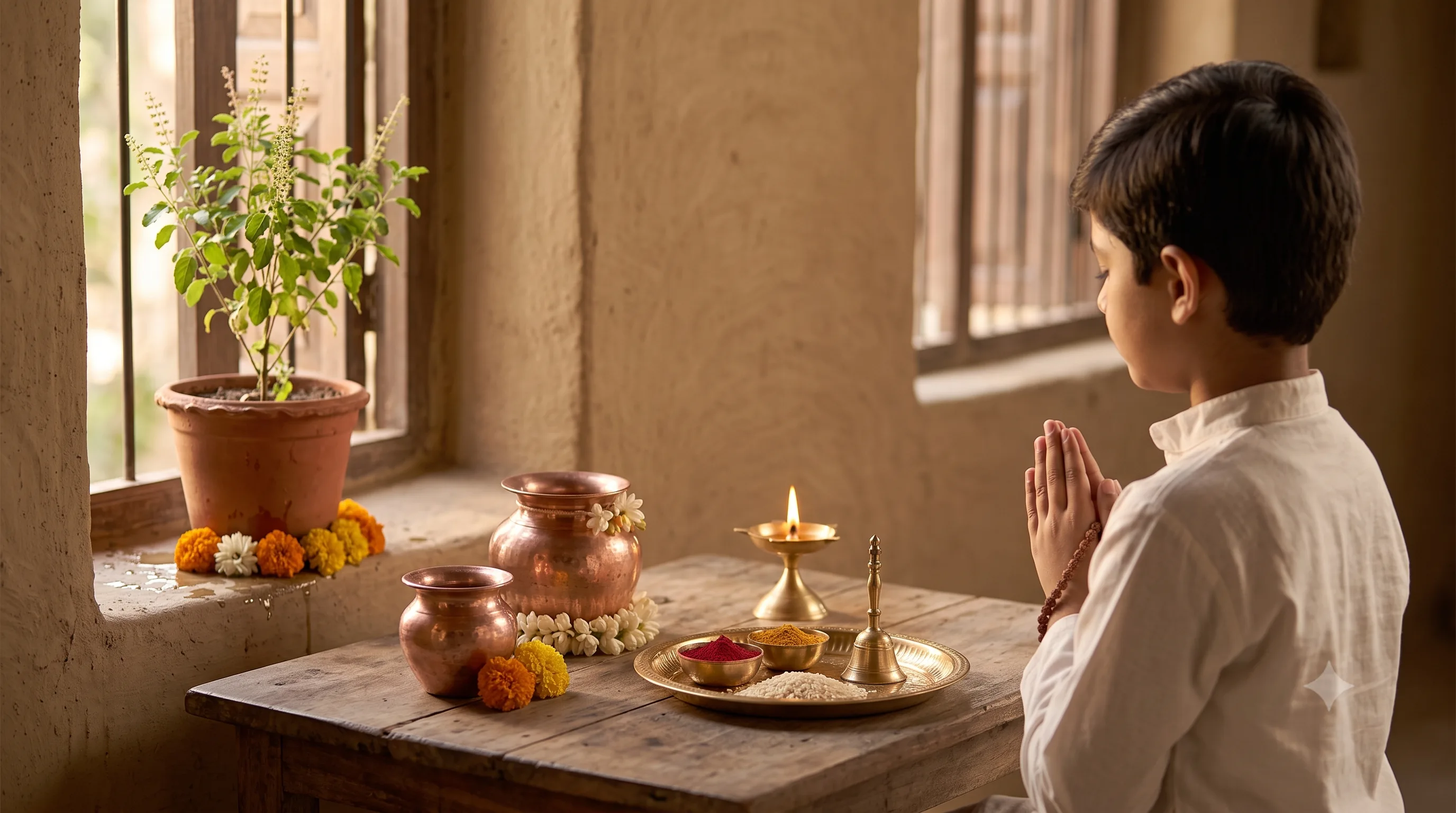
Fifteen daily worship rituals — from Nitya Puja at the home shrine to Sandhya Vandanam and Agnihotra — drawn from Avyani's Master Puja & Ritual Catalogue.
Nitya Karma (नित्य कर्म) — daily religious duty — is the foundation on which every other ritual in Avyani's Master Puja & Ritual Catalogue rests. This category records fifteen rituals rooted in the Grihya Sutras and continued in households across India today.
The Home Shrine
Nitya Puja, daily worship at the home shrine of the family's chosen deity (Ishta Devata), is the most basic and widespread of all Hindu ritual practices. It is typically performed using the Panchopachara (five-offering), Dashopachara (ten-offering) or, for more formal occasions, Shodashopachara (sixteen-offering) method — see our companion guide, Abhishekam and Worship Methods, for these methods in detail.
Vedic Twilight and Fire Practice
Sandhya Vandanam (संध्यावंदनम्), the thrice-daily prayer performed by initiated dwijas at dawn, noon and dusk, and Agnihotra, the twice-daily Vedic fire offering considered the simplest of all yajnas, represent the oldest continuously practised layer of daily Hindu ritual, drawn directly from the Grihya Sutras. Gayatri Upasana, meditative recitation centred on the Gayatri Mantra, is closely related and widely practised beyond the specifically Vedic context.
Everyday Household Devotion
Deepa Puja — the lighting and worship of the lamp (दीपक) at dawn and dusk — and Tulsi Puja — daily worship of the sacred Tulsi (तुलसी) plant kept in many homes — are among the simplest and most universally observed daily practices, needing only a few minutes. Go Puja, the ritual worship and feeding of the cow, and Surya Arghya, the offering of water to the rising sun, are similarly accessible and widespread.
Family and Chosen Deity
Beyond one's Ishta Devata, many families also maintain worship of a Kuldevta (कुलदेवता) — an ancestral family deity — usually on specific tithis or before major family events. Panchayatana Puja, the Smarta method of worshipping five deities (Vishnu, Shiva, Devi, Surya and Ganesha) through symbolic forms, is a more elaborate household tradition within this same daily and periodic practice.
Daily Worship at a Glance
| Ritual | Occasion / Purpose | Typical Duration | Priest Recommended |
|---|---|---|---|
| Nitya Puja | Daily devotion & sanctity of home | 15-30 mins | No |
| Panchopachara Puja | Simple daily worship | 15-20 mins | No |
| Dashopachara Puja | Elaborate daily worship | 30 mins | No |
| Shodashopachara Puja | Complete traditional worship | 45-60 mins | Yes |
| Sandhya Vandanam | Twilight worship & purification | 15-20 mins | No |
| Gayatri Upasana | Spiritual illumination | 20-30 mins | No |
| Agnihotra | Purification of atmosphere & mind | 20-30 mins | Yes |
| Deepa Puja | Dispelling darkness & inauspiciousness | 10 mins | No |
| Tulsi Puja | Health, purity, Vishnu's grace | 10 mins | No |
| Go Puja | Reverence for the sacred cow | 15-20 mins | No |
| Surya Arghya | Health, vitality | 5-10 mins | No |
| Surya Namaskar Puja | Physical & spiritual wellbeing | 15-20 mins | No |
| Panchayatana Puja | Worship of five principal deities together | 30-45 mins | Yes |
| Ishta Devata Puja | Personal spiritual focus | 15-30 mins | No |
| Kuldevta Puja | Family lineage protection | 1-2 hours | Yes |
For a step-by-step walkthrough of the simplest of these practices, see our guide to How to Perform a Simple Home Puja.