


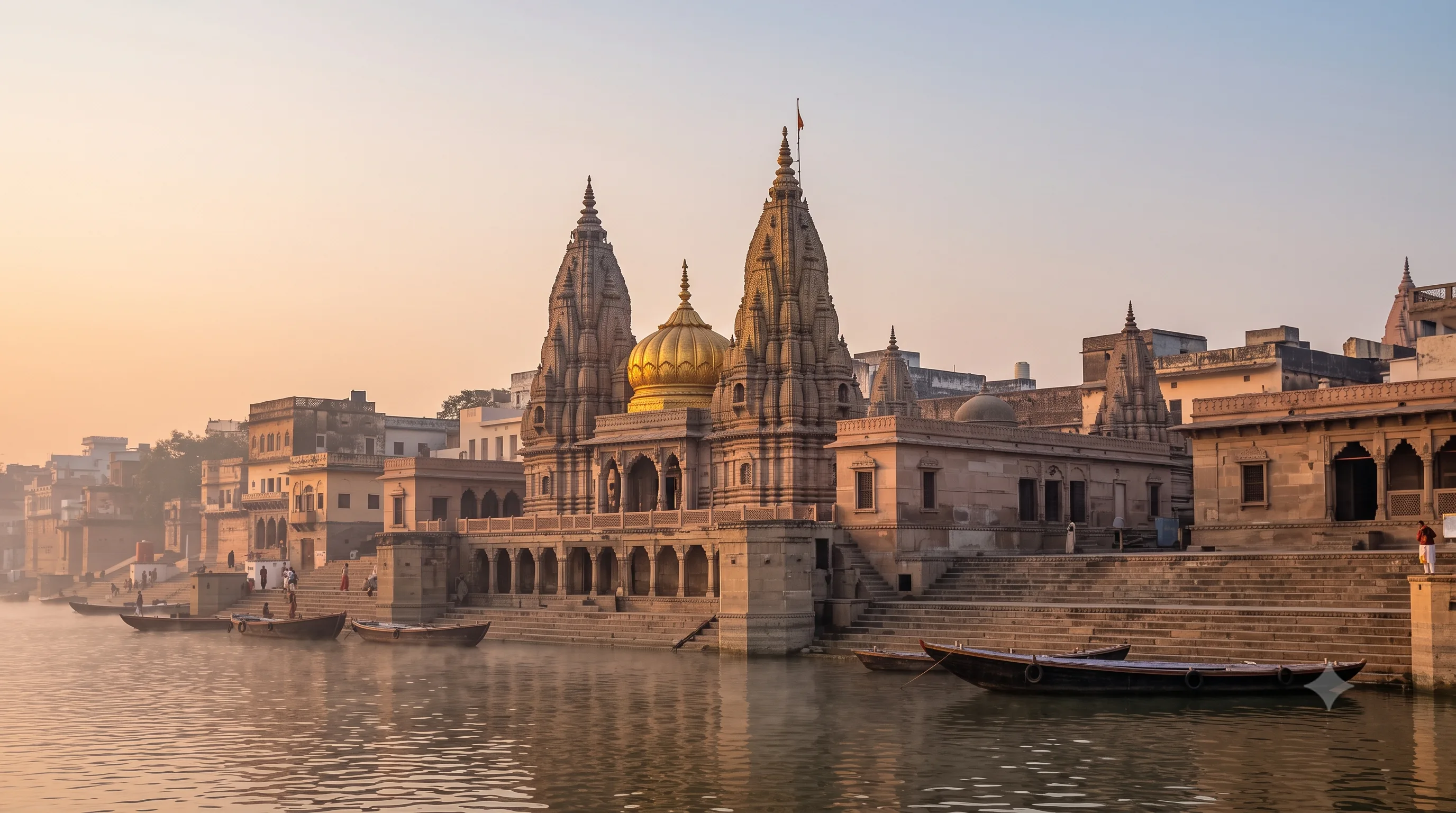
One of the twelve Jyotirlingas of Lord Shiva, Kashi Vishwanath stands on the banks of the Ganga in Varanasi — among the most sacred pilgrimage sites in Sanatan Dharma.
Varanasi is one of the oldest continuously inhabited cities in the world, and close to the Ganga stands the Kashi Vishwanath Temple, dedicated to Shiva in his form as Vishweshwara, "Lord of the Universe." For devotees it is not simply one temple among many; it is counted among the twelve Jyotirlingas, the most sacred of all Shiva shrines.
The Presiding Deity
The temple's presiding deity is Vishweshwara, or Vishwanath — Shiva worshipped in the form of a Jyotirlinga, understood in tradition as a pillar of light without beginning or end. The wider temple complex includes shrines to other deities associated with Shiva's worship, including Ganesha and forms of Devi.
Spiritual and Scriptural Significance
Kashi, as Varanasi is traditionally known, holds a distinct place in Hindu belief. The Kashi Khanda section of the Skanda Purana is devoted to describing the city's sanctity, and tradition holds that Shiva himself resides here permanently — a belief that has drawn pilgrims to the city for centuries, distinct from any historical claim about the temple building itself. A well-known verse from the traditional Dwadash Jyotirlinga Stotram, popularly attributed to Adi Shankaracharya, names Vishweshwara among the twelve Jyotirlingas:
वाराणस्यां तु विश्वेशं त्र्यम्बकं गौतमीतटे ।
vārāṇasyāṃ tu viśveśaṃ tryambakaṃ gautamītaṭe
"In Varanasi, Vishweshwara; and on the banks of the Gautami (Godavari), Trimbakeshwar." The line pairs two of the twelve Jyotirlingas, as the stotra does throughout, and is recited by many devotees as a simple way of holding all twelve shrines in mind together.
A History of Destruction and Renewal
The documented history of the temple at this site is one of repeated destruction and rebuilding. In 1669, the Mughal emperor Aurangzeb ordered the temple demolished, and the Gyanvapi Mosque was built adjoining the site — a well-recorded event of the period. The temple standing today was built in 1780 by the Maratha queen Ahilyabai Holkar of Indore, and in 1835 the Sikh ruler Maharaja Ranjit Singh donated gold for the plating of its dome. In December 2021, the Kashi Vishwanath Corridor was inaugurated, creating a direct pedestrian route between the temple and the Ganga's Lalita Ghat.
Traditions and Worship
The temple follows a daily cycle of aartis, from the Mangala Aarti before dawn to the Shringar and Shayan Aarti at night. Rudrabhishek, the ritual bathing of the Shivalinga described in our Abhishekam and Worship Methods guide, is among the most common personal offerings made here, alongside the wider forms of worship described in our Shiva Rituals guide. The temple's location, a short walk from the Ganga ghats, means a visit is traditionally combined with bathing in the river; some pilgrims also visit nearby Manikarnika Ghat, associated in tradition with liberation (moksha) for those who pass away in Kashi.
What a Devotee Should Know Before Visiting
Security screening is thorough given the temple's location, and mobile phones, cameras and leather items are commonly restricted inside the inner complex — it is worth checking the temple's current entry rules before arriving, as these are periodically updated. Darshan queues can be long, particularly during Shravan month and around Maha Shivaratri; many pilgrims plan an early-morning visit for the Mangala Aarti to avoid the heaviest crowds. Modest, traditional dress is generally expected.
Location and Access
The temple stands in the heart of Varanasi, Uttar Pradesh, on the western bank of the Ganga, connected to Lalita Ghat by the Kashi Vishwanath Corridor. Varanasi is well connected by rail and air, and remains one of the most visited pilgrimage cities in North India.