


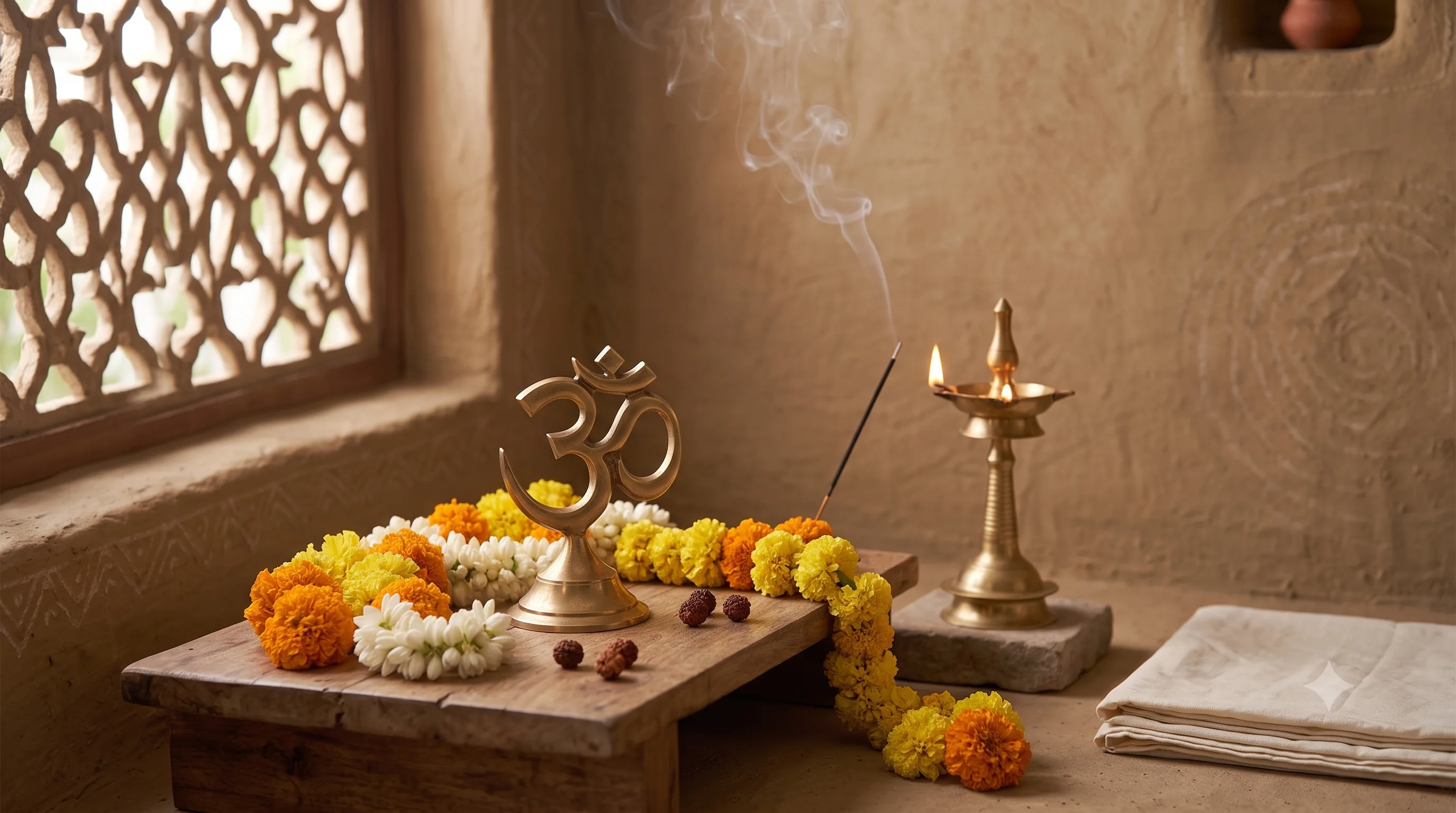
Om (ॐ, also written Aum) is considered the primordial sound of the universe in Hindu tradition and opens mantras, prayers and scriptural recitation across virtually every school and sampradaya. It is one of the few symbols used with near-universal consistency across Hindu practice, regardless of which deity is being worshipped.
The Three (or Four) Sounds
Phonetically, Om is composed of three sounds — A, U and M — often explained as representing a set of threefold states: waking, dreaming and deep sleep; or creation, preservation and dissolution, corresponding to Brahma, Vishnu and Shiva. The Mandukya Upanishad, a short but philosophically dense text devoted entirely to this syllable, describes a fourth, silent state (turiya) beyond the three sounds — the state of pure awareness said to underlie and transcend the other three.
Why It Opens Most Mantras
Reciting Om before a mantra is traditionally understood to align the practitioner's attention and invoke auspiciousness before the specific request or praise that follows. The Gayatri Mantra, among the most widely recited of all Vedic mantras in daily worship, begins this way, as do countless others across Vedic, Puranic and Tantric traditions. Krishna himself speaks directly to this practice in the Bhagavad Gita:
ओमित्येकाक्षरं ब्रह्म व्याहरन्मामनुस्मरन्।
यः प्रयाति त्यजन्देहं स याति परमां गतिम्॥
Bhagavad Gita, Chapter 8, Verse 13
Here Krishna describes someone who, at the moment of death, utters this single syllable while holding Krishna in mind, and says that such a person reaches the highest state. Tradition has long read this verse more broadly than its immediate context: as a statement that Om itself is Brahman, the ultimate reality, condensed into a single sound. That is essentially why Om is treated as fit to open almost anything spoken with sacred intent — not only at the end of life, but at the start of every prayer.
Om in Daily Practice
Beyond mantra recitation, Om is chanted on its own — often three times — as a meditative practice, used to settle the mind before puja, study or seated meditation. It appears inscribed on temple gates, puja items and religious texts as a mark of sanctity, and is drawn or written at the start of many devotional and even everyday documents in traditional households.
A Note on Meaning
Different schools of Hindu philosophy — Vedanta, Yoga, and various Tantric traditions among them — offer somewhat different accounts of Om's deeper significance. What is shared across nearly all of them is the sense that Om represents something prior to and beyond ordinary language: an attempt to give sound to the reality that sound itself points toward but cannot fully capture.