


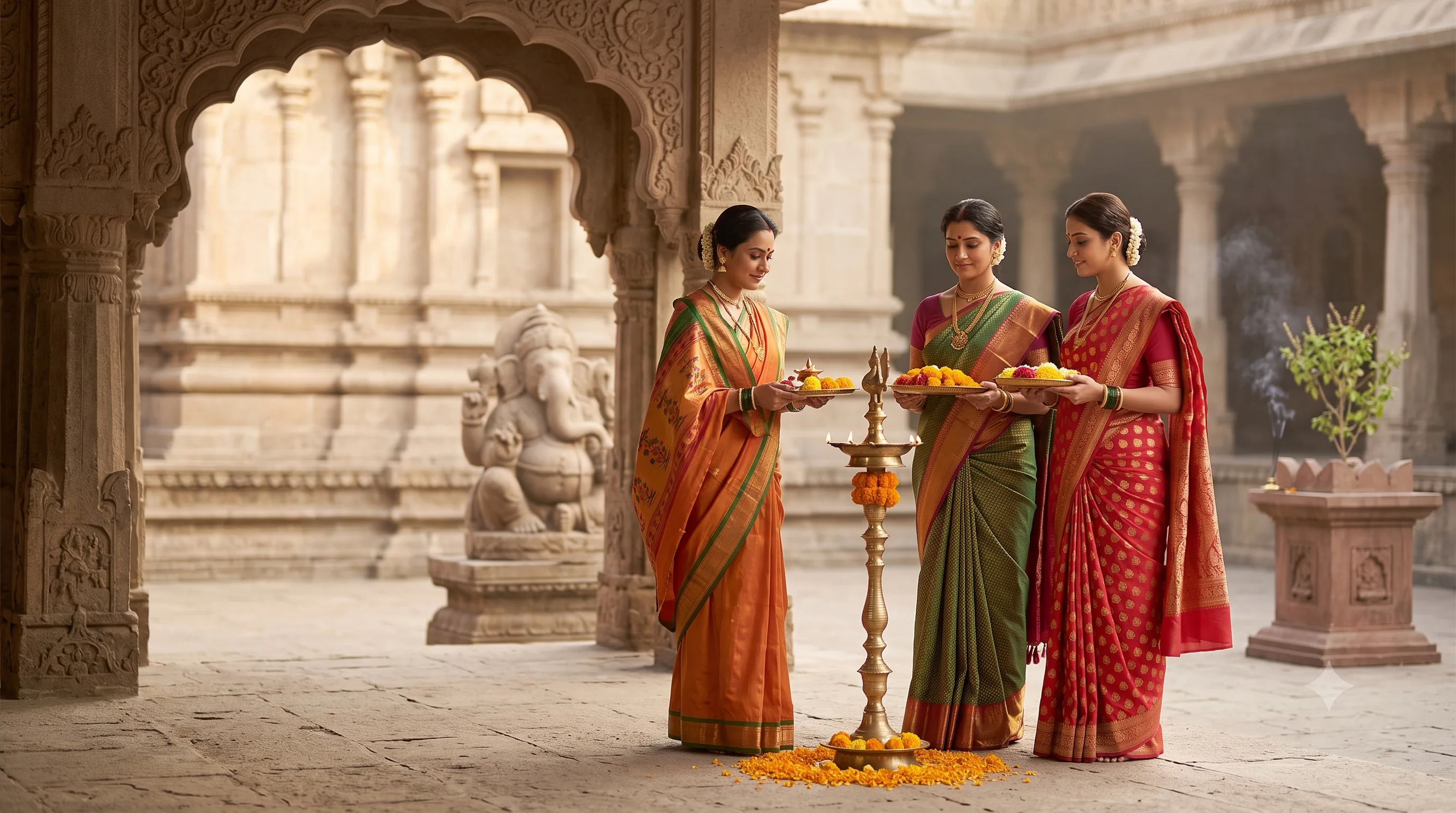
Sixteen rituals that belong to one place rather than to a pan-Indian deity category — Theyyam in north Kerala, Bastar's seventy-five-day Dussehra, the Ganga aarti at Kashi. India's ritual life is not one practice but many, and this guide records that plainly.
India's ritual life is not one uniform practice but a living diversity of regional and community traditions, each rooted in its own land, language and lineage. Avyani's Master Puja & Ritual Catalogue records sixteen rituals that do not sit under a pan-Indian deity category.
Everything here is regional practice in the strict sense, and several entries belong to communities with their own priesthoods, their own calendars and their own authority over how they are described. This guide reports rather than instructs.
Kerala
Theyyam (തെയ്യം) is the ritual art of north Kerala in which a performer, after long preparation, takes on the form of a local deity or ancestral spirit — elaborate costume, painted face, towering headdress — and is then addressed as that deity by the community, giving blessings and hearing grievances through the night. The performers come largely from communities historically placed low in the caste order, and during the possession that order is inverted. It is among the most remarkable ritual forms anywhere.
Thrissur Pooram is Kerala's grandest temple festival, with caparisoned elephants, the panchavadyam percussion ensembles and the parasol exchange. Sarpa Kavu Puja honours serpent deities in the sacred groves attached to ancestral homes — small patches of forest left uncut for generations, and among the oldest surviving conservation practices in the subcontinent.
The Himalaya and the North
Kullu Dussehra begins where most Dussehras end. Village deities are carried in from across the valley on palanquins to attend on Raghunathji for seven days — a gathering of local gods rather than a Ramlila.
Kashi Ganga Aarti is the evening lamp offering to the river at Dashashwamedh Ghat, performed daily by trained priests with tiered lamps. Our Festival Rituals guide covers Ganga Dussehra, the river's own festival.
The West
Gangaur is Rajasthan's spring festival for Gauri, kept over eighteen days chiefly by women, and Teej its monsoon counterpart. Khandoba Jagran is the night vigil for the Maharashtrian and Karnataka folk deity Khandoba, sung through the night at Jejuri and elsewhere. Rann Utsav Deity Rituals belong to the Kutch season.
The East and Centre
Rath Yatra of Mahesh in Serampore, Bengal, is held to be the second-oldest chariot festival in India after Puri's. Jhulan Yatra swings Radha and Krishna through the monsoon month, and is kept across Bengal, Odisha and Braj.
Bastar Dussehra runs seventy-five days — the longest observance in this entire catalogue — and is not about Rama at all: it honours Danteshwari, the presiding goddess of Bastar, and is a tribal and royal observance jointly held.
Harvest and the Forest
Four entries belong to communities whose ritual year follows the crop. Karam Puja honours the karam tree across Jharkhand, Odisha and Chhattisgarh; Sarhul marks the sal blossom and the start of the year among the Oraon, Munda and Ho; Nuakhai offers the season's new rice in western Odisha; and Chapchar Kut is the Mizo spring festival following the clearing of jhum fields.
These stand alongside the agrarian observances in our Agricultural, Seasonal and Protection Rituals guide, and the great regional harvest festivals — Onam, Pongal, Bihu, Baisakhi — in our Festival Rituals guide.
What a Catalogue Cannot Hold
Sixteen entries is a sample, not a survey. India's regional and community traditions run into thousands, many with no written liturgy and no interest in acquiring one, and a family's own kuladevata observance may appear in no catalogue anywhere.
Avyani records what it can verify and names the tradition it belongs to. Where a community holds its own practice, that community is the authority on it, and this guide defers to them.
Regional Rituals at a Glance
Durations are typical planning ranges. "Traditionally for" records the intention the tradition assigns — not an outcome Avyani predicts or guarantees.
| Ritual | Tradi |
Typical duration | Priest advised |
|---|---|---|---|
| Theyyam Rituals | The deity embodied; north Kerala | Full night | Yes |
| Thrissur Pooram Sevas | Kerala's grand temple festival | 1–2 days | Yes |
| Sarpa Kavu Puja | Serpent groves; Kerala | 1 day | Yes |
| Kullu Dussehra Rituals | Village gods gathered | 7 days | Yes |
| Kashi Ganga Aarti | Lamps for the river | 45–60 mins | Yes |
| Gangaur Puja | Gauri; a Rajasthani spring | Multi-day | No |
| Teej Festival Rituals | The monsoon; Rajasthan | 1 day | No |
| Khandoba Jagran Puja | A night vigil for Khandoba | Full night | Yes |
| Rann Utsav Deity Rituals | The Kutch season | 1 hour | No |
| Rath Yatra of Mahesh | Bengal's chariot festival | Multi-day | Yes |
| Jhulan Yatra | The monsoon swing | Multi-day | No |
| Bastar Dussehra Rituals | Danteshwari; Bastar | 75 days | Yes |
| Karam Puja | The karam tree; harvest | 1 day | No |
| Sarhul Rituals | The sal blossom; new year | 1 day | Yes |
| Nuakhai Rituals | New rice; western Odisha | 1 day | No |
| Chapchar Kut Rituals | Mizo spring festival | 1 day | No |
Sources
- Theyyam as a north Kerala ritual form performed largely by communities historically placed low in the caste order, with the social order inverted during possession — documented regional practice.
- Sarpa kavu as sacred groves attached to ancestral homes, and among the oldest surviving conservation practices in the region.
- Kullu Dussehra as a gathering of village deities on palanquins; Bastar Dussehra as a seventy-five-day observance of Danteshwari rather than a Rama festival — documented regional practice.
- Karam, Sarhul, Nuakhai and Chapchar Kut as community harvest and seasonal observances of Jharkhand, Odisha, Chhattisgarh and Mizoram.
- Ritual names, durations and priest-advised flags — Avyani Master Puja & Ritual Catalogue. Durations are planning ranges, not prescriptions.
Everything here is regional practice rather than scripture, and is described as such. Where a community holds its own tradition, that community is the authority on how it is described. Stated purposes are the intentions the tradition assigns, not outcomes Avyani predicts.